
The Pulse - The load no one sees
It is twenty to eight on a Tuesday. She was up at six to fit in a workout before anyone else woke.
Since then she has moved her mother’s appointment, replied to a message from school and rewritten the agenda for the nine o’clock.
She has already done everything she knows needs doing.
None of it will appear anywhere. Not in her diary, not in her objectives, not in any measure of what she delivered today. She will still be the most prepared person in the room.
When researchers at the Universities of Bath and Melbourne asked who does the thinking that keeps family life running, the anticipating, planning and remembering, mothers were doing around 71% of it. Income and career success made no difference.[1]
She is not the only one
If this sounds familiar, it is because it is common. Burnout among senior women is now at its highest level in five years, with 60% saying they frequently feel burned out, compared with 50% of senior men.[2]
And it is not for lack of commitment. Women leaders report more engagement and more ambition than men, and more burnout at the same time.[3]
Commitment is not the issue. Capacity is.
The load follows her into work too. Women are asked more often than men to pick up the tasks that keep everything running but rarely lead to promotion, and they are more likely to say yes.[4]
In one organisation, that added up to 200 extra hours a year for each woman.[5] A month of work nobody counted.
None of this shows up in an appraisal. It shows up later, as a resignation, a promotion declined, or an absence with a different reason on the form.
An organisation that only measures output will always be the last to know what producing it is costing.
Around the breakfast table
In October we hosted two private breakfasts in Garstang for women in business and leadership, built around one question: what if you didn’t have to achieve anything?
Women who arrived as strangers found they were carrying remarkably similar things. Different roles, different sectors, different households. The same unseen load.
One woman summed it up simply:
“It was great to be with other women who got it.”
That is the part no report captures.
Not a solution. Recognition.
Being understood without having to explain is rare for women who spend most of their day explaining.
Why it stays unseen
The Unseen Load is not one thing. It is the sum of what sits beneath the performance:
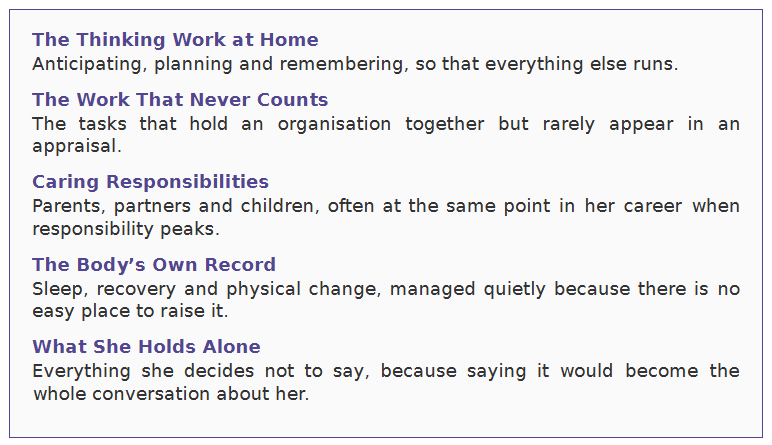
Each one is reasonable on its own.
Together, they are rarely seen by anyone.
Sometimes not even by her.
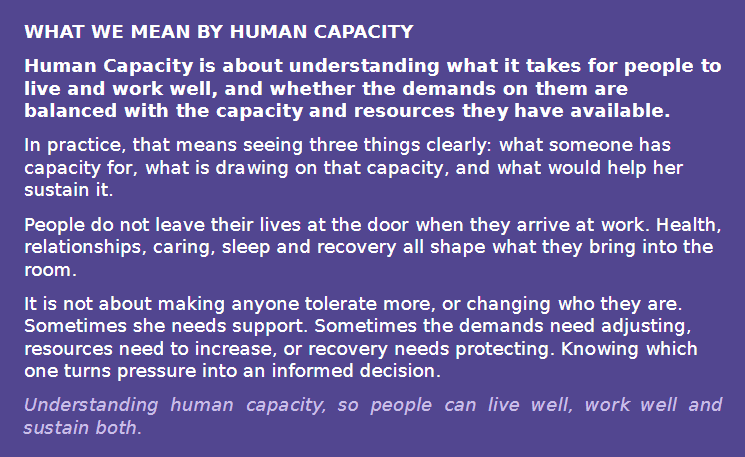
Behind all of this sits one idea, and it shapes everything we do.
Where to start
For the individual leader, The Unseen Load is where Human Capacity begins. A short reflection across five areas: your nervous system, demand and recovery, sleep, the load you carry alone and your body as data.
It takes around ten minutes and gives you a personal map you can download and keep.
Your results are yours. They are never shared with an employer.
For organisations, the same thinking applies at scale. Our Stress Risk Assessment and the OHFB show where demands and resources are out of balance across teams, so decisions rest on evidence rather than on what the output suggests.
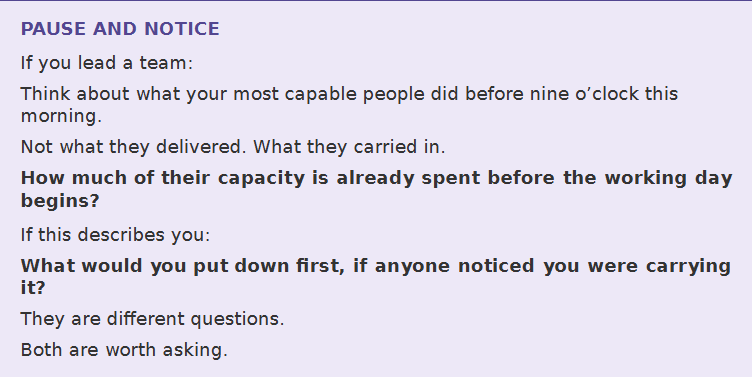
The load no one sees is still part of the work.
Every organisation is already paying for it, in exhaustion, in quiet resignations and in promotions declined for reasons nobody writes down. The only question is whether anyone is measuring it.
If this has named something you have been carrying, we would welcome a conversation.
If it named you, take ten minutes with The Unseen Load: unseenload.co.uk
EVIDENCE & SOURCES [1] University of Bath: Mothers bear the brunt of the mental load [2] McKinsey & Company and LeanIn.Org: Women in the Workplace 2025 [3] Gallup: Women Show Stronger Employee Engagement Amid Higher Burnout [4] Harvard Gender Action Portal: Babcock et al., gender differences in non promotable tasks [5] TED: Protecting your time with Linda Babcock (transcript)