
The Pulse - The lag between what you see and what is already happening
There is a version of performance you can see. Revenue, output, delivery, engagement scores. These are the numbers you report, the metrics you review, the indicators you are accountable for.
And then there is the version you cannot see, not easily, and not in time.
The decision that came out slightly wrong because the person making it had been running on not enough sleep for two weeks. The conversation that closed down instead of opening up because the leader in the room was carrying more than they let on. The team that quietly stopped raising problems because the atmosphere around raising problems had become subtly, invisibly unsafe
None of this shows up in a dashboard. By the time it shows up anywhere measurable, the cost has already been paid.
Performance is always a lagging indicator. What you measure today reflects decisions made weeks or months ago, by people operating in conditions you may never have examined. The conditions themselves are the thing.
The performance that matters most is happening upstream of the results you can see. And it is shaped, every day, by the internal state of the people leading it.
Most organisations understand this instinctively. Leaders feel it without always having language for it. The team that used to be sharp and is now sluggish. The individual who is technically doing everything asked of them but is clearly not really present. The meeting that is technically productive and yet leaves everyone feeling vaguely worse.
These are not personality problems. They are not motivation problems. They are system signals, the human system communicating something that the performance system has not yet registered.
The delay is the problem.
In February we wrote about the human conditions beneath performance, the invisible strain that shapes output before results shift. In March we looked at what happens inside a leadership system under sustained pressure, and how that internal state travels outward into tone, decision quality and relational safety.
April is the harder question: what if you are already past the point where you would notice?
The research on cognitive load and sustained stress is unambiguous on this point.
One of the effects of operating under accumulated demand for a long period is that your ability to accurately assess your own state declines. You feel fine because you have adapted to not feeling fine. Your baseline has quietly shifted and the new normal does not feel abnormal, because it has become your normal.
Leaders operating in threat-adapted states often report feeling focused, driven, even clear. What they are describing is not clarity. It is narrowing.
Narrowing looks like decisiveness from the inside. It looks like conviction. It feels like leadership. And sometimes it is. But sometimes it is a system running on adrenaline and momentum, executing with speed and diminishing wisdom, and the gap between those two things is not always visible until the cost arrives.
What this actually costs.
It costs decision quality, not catastrophically, but incrementally. The slightly worse call. The option not considered. The risk not weighed with quite the care it deserved.
It costs relational safety. A leader operating at capacity is harder to read, harder to approach, and harder to challenge. The people around them pick this up and adjust accordingly, saying less, raising less, carrying more of the gap themselves. The leader often does not know this is happening.
It costs recovery time. Systems that are run without adequate recovery do not just plateau, they become progressively harder to restore. The debt accumulates. And at a certain point, recovery requires not just rest but active intervention, because the system no longer knows how to return to a baseline it has not experienced for some time.
None of this is dramatic. That is exactly the point. It happens quietly, in increments, in organisations full of capable and committed people who are genuinely trying their best. The problem is not effort or intention. It is the absence of a system for noticing what effort and intention cannot see.
Noticing requires something different.
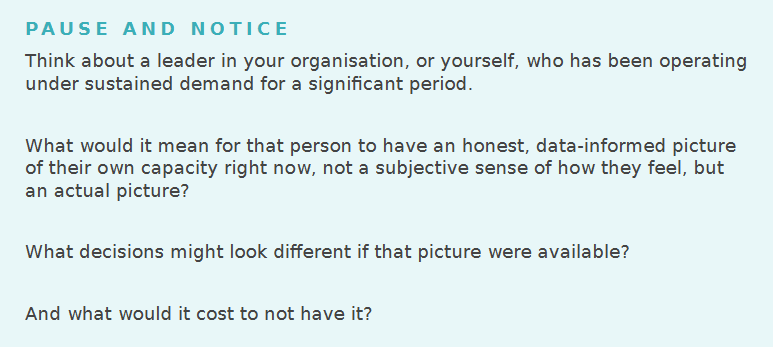
It requires data that sits outside your own assessment of yourself, because your assessment is one of the things that shifts under sustained load. Physiological data.
Honest reflection. The kind of structured questions that bypass the well-rehearsed answers and reach something closer to what is actually true.
It requires leaders who are willing to look at themselves as a system, with the same curiosity and rigour they apply to the systems they lead. Not from self-criticism.
From the recognition that the internal state of a leader is not a personal matter, it is an organisational one.
And it requires time, not a lot of it, but some. A moment to stop measuring output and start examining conditions. To ask not what has been produced, but what the system producing it is actually capable of sustaining.
Organisations that outperform over time are not the ones that push hardest.
They are the ones that understand what their systems can hold — and build accordingly.
That is not soft. It is not a wellbeing initiative in the conventional sense. It is a performance discipline. The same kind of discipline that elite sport figured out decades ago and that organisational leadership is only beginning to take seriously.
The question is not whether your people are working hard enough. They almost certainly are.
The question is whether the system behind the work is being given what it needs to remain capable.
The most important data in your organisation has no column.
The performance you cannot measure is still shaping the performance you can.